

Thanks to the bioclimatic chamber, we can simulate temperature, light and relative humidity under controlled conditions. This allows us to carry out preliminary tests aimed at studying how plants will behave, the functioning of products and substances in any region of the world or circumstances. Therefore, the climatic chamber is a very useful and differential tool, which is used as a preliminary step to transferring these tests to the field.
On this occasion, the Econatur Innovation department shows us a test in a climatic chamber with the aim of studying how biostimulation technology influences plants committed under climatic and water stress. This study is carried out in 3 key moments for the plant: 1. Transplant, 2. Fruit set 3. Filling.
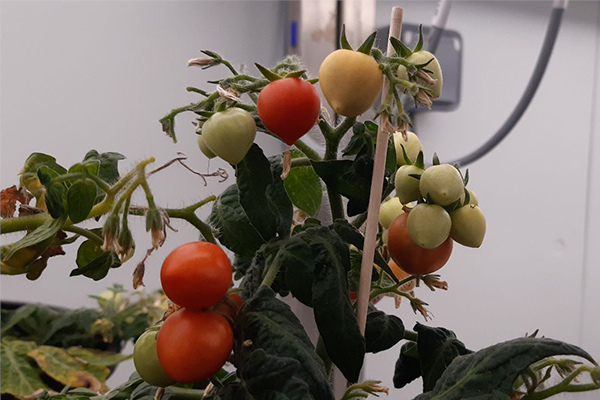
For this test, it has been used tomato of a special variety to be able to work in the laboratory, the Micro Tom variety.
In the first place, the plants were subjected to water stress for a specific time, and then applied to a certain number of our biostimulants, leaving other plants without application to be used as a control.
In order to study how the plants reacted to this situation, the hydrogen peroxide accumulation test in the leaf tissues was carried out. As can be seen in the comparative image of the video, the accumulation of hydrogen peroxide in the control leaves is much higher than in the plants that were treated with Econatur biostimulation technology, where a healthier leaf was observed, without a hardly presence of hydrogen peroxide. Therefore, the analyzes show how the plants treated with Econatur biostimulation were in better conditions than those untreated plants (control).
Thanks to this test, it can be concluded that plants subjected to climatic stress can recover quickly and satisfactorily, through the application of biostimulation technology.